How COVID-19 pushes new virtual and augmented reality applications
Pandemic restrictions accelerated global interest in VR and AR. How the DigiCenter supports the community on the ground in Rwanda — from a virtual tour of the centre to a VR/AR lab and community of practice.
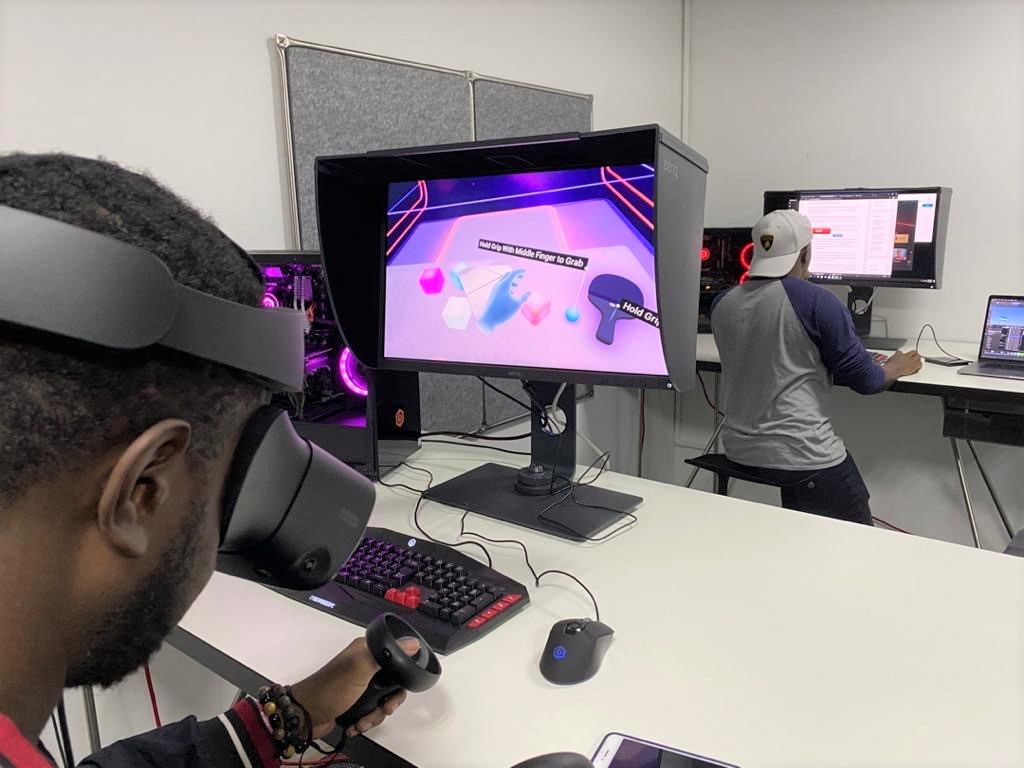
o transform how our societies work and communicate, emerging technologies such as artificial intelligence, the Internet of Things, virtual reality (VR), augmented reality (AR) and blockchain have come into play. The DigiCenter pushes for practical development and knowledge exchange around these technologies and has established transfer and AR/VR labs on site. Through the AR/VR lab, solution development becomes more interactive, engaging and efficient — a meeting point where content creators, gamers and inventors form ideas and display them in VR/AR. They meet regularly at the DigiCenter or online through our AR/VR Community of Practice.
In the simplest of terms, Virtual Reality replaces reality with a completely new 3D digital environment, while Augmented Reality overlays digital content on top of the real world. Both can be applied across health, agriculture, education, tourism and banking, and they bring unlimited possibilities for teaching and learning.
Using VR and AR through the pandemic
COVID-19 challenged many of us to think outside the box about how to interact and bring people together amidst restrictions. Through virtual reality, several industries — most visibly education — have benefitted from the ability to collaborate remotely. In tourism, where international travel collapsed, VR has been used to substitute real travel: a study published by Cham Springer examined the role of VR as a substitute for real travel and showed the technology's potential to induce travel experiences.
This is not to say VR/AR will not thrive after COVID-19 — rather, the pandemic has helped people realise the many benefits of using these technologies. According to Steve Dann, co-founder of Medical Realities, the pandemic will definitely drive adoption of AR and VR in healthcare and education.
Virtual and augmented reality at the DigiCenter
Because of the DigiCenter's interest in seeing the VR industry in Rwanda progress, we engaged Kigali360 — a Rwandan company that builds virtual tours and VR-ready websites — to create a virtual tour of the Digital Transformation Center. The tour allows anyone to experience the centre from any part of the world.
VR/AR enthusiasts also meet regularly to exchange the newest trends and local projects. These community meet-ups are hosted by the DigiCenter in partnership with DopeApps. If you are passionate about VR/AR, you can become a member of our Communities of Practice.
— From the field